For this lab we tested reactions. The purpose was to discover different characteristics of different types of reactions. This lab consisted of 7 reactions.
Reaction 1:
Here, we filled a test tube 1/2 full with 3M HCL (aq) -hydrochloric acid, placed the test tube on a rack where it would stay in place, places a second tube into the holder, and placed a magnesium strip into the test tube. We held the second test tube in an inverted position over the tube with the acid contents and let the gas from the the acid tube (or "tube on bottom") go into the second. The two tubes were held like so until the reaction of magnesium against the acid (magnesium strip dissolving) was complete. From here, we rotated the test tube to aim away from anything or anyone and lit a match, which was held to the end of the test tube.
-The magnesium strip placed in the first container dissolved against the hydrochloric acid. Gas was released to the second test tube.
-When match was held to test tube, a sharp, loud noise was created. Some would describe this as a "pop".
- Gas in tube exploded
HCL + Mg -> H2 + MgCl2
Reaction 2:
For this reaction, my group lit a Bunsen burner. In a pair of tongs, we held a small strip of magnesium over it, in the flames. The magnesium caught the fire and was soon aflame. When it was finished, it was placed in a glass to allow cooling before disposed in trash.
- The magnesium caught fire
- Burned very bright white
- White ashes left
Mg + O2 -> MgO
Reaction 3:
A piece of copper wire was shined using a piece of sand paper. Using tongs, the wire was held in the flame of the Bunsen burner for several minutes, and copper was finally returned to its proper container.
- The color of the wire began to change as it burned.
- Burning dark colors-black and red
- Brought green tint to the flame
Cu + O -> CuO
Reaction 4:
A small amount of ammonium carbonate (NH4)2 CO3 was added into a test tube, which was gently heated. The mixture's gas was wafted for testers to smell.
- Ammonium carbonate, when heated, smells like alcohol
- No substance left over
(NH4)2 CO3 -> NH3 + CO2 + H2O
Reaction 5:
A test tube was 1/2 filled with hydrogen peroxide, H2O2. To this was added a smalla mount of manganese dioxide, MnO2. using the test tube holder, and inverted test tube was held over the first tube. Once the reaction was complete, a splint was it and waved until it no longer burned. Immediately, the glowing splint was put into the inverted test tube. A reaction took place.
- Mixture bubbled up rapidly
- Splint's flame relit and caught fire even though it was going down
H2O2 + MnO2 -> O2
Reaction 6:
A small amount of potassium iodide, KI, was poured into a test tube. Next, a small amount of lead (II) nitrate, Pb(NO3)2 was poured into another test tube. Observations were recorded and contents of both test tubes were poured into a waste container.
- Potassium iodide; lead nitrate -> clear
- Potassium + lead nitrate = Yellow
KI + Pb(NO3)2 -> KNO3 + PbI2
Reaction7:
A small amount of copper (II) carbonate, CUcO3, was placed into a test tube. One test tube holder was used to heat that tube while a second test tube (this one inverted) was used to collect any gas given off. I wooden splint was lit and placed into the inverted test tube. Water was added to the test tubes and contents were disposed of.
- burned up
- Smoke in inverted tube was moving downward, almost like falling, or being pushed down
CuCO3 -> CO2 + CuO
So different chemicals have different reactions and different properties! Some may have similarities, but they are all different in some way.
COOL!
Wednesday, December 14, 2011

Thursday, December 1, 2011
Metal Activity Lab
Today in chemistry, we did a metal activity where we placed 8 drops of each of the solutions of Copper (II) nitrate, Magnesium nitrate, Zinc nitrate, and Silver nitrate in a 24 well plate. After this, we placed a small copper wire in each row of A wells, a small magnesium ribbon in each of the B wells, and a few zinc granules in the C wells (we only put the chemicals in to the 3rd well-C.) After, we recorded the following reactions:
( + = reaction)
( - = no reaction)
Cell Letter Metal 1 2 3 4
Cu2+No3 1- Mg2+NO3 1- Zn2+NO3 1- Ag1+NO3 1-
A Cu - - - +
B Mg + - - +
C Zn + - - +
copper (II) nitrate- Cu(NO3)2
Magnesium nitrate- Mg(NO3)2
Zinc Nitrate- Zn(NO3)2
Silver nitrate- AgNO3
 In order from least to greatest, the reactant chemicals were Zn(NO3)2, Mg(NO3)2, Cu(NO3)2, and AgNO3.
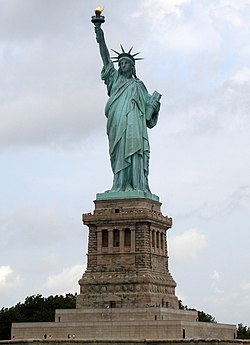
So plugging this into my daily life, the statue of liberty, for example, is made of copper. Why so? Well copper reacted least to other chemicals going into contact with it. Therefore, this would be a great choice to use for building things that could potentially come in contact with other chemicals (and weathering, of course!).
Now, if we placed a copper penny into a solution of lead (II) nitrate, it would react because lead reacts to copper. So copper will react to lead! They come together and react.
( + = reaction)
( - = no reaction)
Cell Letter Metal 1 2 3 4
Cu2+No3 1- Mg2+NO3 1- Zn2+NO3 1- Ag1+NO3 1-
A Cu - - - +
B Mg + - - +
C Zn + - - +
copper (II) nitrate- Cu(NO3)2
Magnesium nitrate- Mg(NO3)2
Zinc Nitrate- Zn(NO3)2
Silver nitrate- AgNO3
 In order from least to greatest, the reactant chemicals were Zn(NO3)2, Mg(NO3)2, Cu(NO3)2, and AgNO3.
So plugging this into my daily life, the statue of liberty, for example, is made of copper. Why so? Well copper reacted least to other chemicals going into contact with it. Therefore, this would be a great choice to use for building things that could potentially come in contact with other chemicals (and weathering, of course!).
Now, if we placed a copper penny into a solution of lead (II) nitrate, it would react because lead reacts to copper. So copper will react to lead! They come together and react.
Subscribe to:
Comments (Atom)