For this lab we tested reactions. The purpose was to discover different characteristics of different types of reactions. This lab consisted of 7 reactions.
Reaction 1:
Here, we filled a test tube 1/2 full with 3M HCL (aq) -hydrochloric acid, placed the test tube on a rack where it would stay in place, places a second tube into the holder, and placed a magnesium strip into the test tube. We held the second test tube in an inverted position over the tube with the acid contents and let the gas from the the acid tube (or "tube on bottom") go into the second. The two tubes were held like so until the reaction of magnesium against the acid (magnesium strip dissolving) was complete. From here, we rotated the test tube to aim away from anything or anyone and lit a match, which was held to the end of the test tube.
-The magnesium strip placed in the first container dissolved against the hydrochloric acid. Gas was released to the second test tube.
-When match was held to test tube, a sharp, loud noise was created. Some would describe this as a "pop".
- Gas in tube exploded
HCL + Mg -> H2 + MgCl2
Reaction 2:
For this reaction, my group lit a Bunsen burner. In a pair of tongs, we held a small strip of magnesium over it, in the flames. The magnesium caught the fire and was soon aflame. When it was finished, it was placed in a glass to allow cooling before disposed in trash.
- The magnesium caught fire
- Burned very bright white
- White ashes left
Mg + O2 -> MgO
Reaction 3:
A piece of copper wire was shined using a piece of sand paper. Using tongs, the wire was held in the flame of the Bunsen burner for several minutes, and copper was finally returned to its proper container.
- The color of the wire began to change as it burned.
- Burning dark colors-black and red
- Brought green tint to the flame
Cu + O -> CuO
Reaction 4:
A small amount of ammonium carbonate (NH4)2 CO3 was added into a test tube, which was gently heated. The mixture's gas was wafted for testers to smell.
- Ammonium carbonate, when heated, smells like alcohol
- No substance left over
(NH4)2 CO3 -> NH3 + CO2 + H2O
Reaction 5:
A test tube was 1/2 filled with hydrogen peroxide, H2O2. To this was added a smalla mount of manganese dioxide, MnO2. using the test tube holder, and inverted test tube was held over the first tube. Once the reaction was complete, a splint was it and waved until it no longer burned. Immediately, the glowing splint was put into the inverted test tube. A reaction took place.
- Mixture bubbled up rapidly
- Splint's flame relit and caught fire even though it was going down
H2O2 + MnO2 -> O2
Reaction 6:
A small amount of potassium iodide, KI, was poured into a test tube. Next, a small amount of lead (II) nitrate, Pb(NO3)2 was poured into another test tube. Observations were recorded and contents of both test tubes were poured into a waste container.
- Potassium iodide; lead nitrate -> clear
- Potassium + lead nitrate = Yellow
KI + Pb(NO3)2 -> KNO3 + PbI2
Reaction7:
A small amount of copper (II) carbonate, CUcO3, was placed into a test tube. One test tube holder was used to heat that tube while a second test tube (this one inverted) was used to collect any gas given off. I wooden splint was lit and placed into the inverted test tube. Water was added to the test tubes and contents were disposed of.
- burned up
- Smoke in inverted tube was moving downward, almost like falling, or being pushed down
CuCO3 -> CO2 + CuO
So different chemicals have different reactions and different properties! Some may have similarities, but they are all different in some way.
COOL!
Wednesday, December 14, 2011

Thursday, December 1, 2011
Metal Activity Lab
Today in chemistry, we did a metal activity where we placed 8 drops of each of the solutions of Copper (II) nitrate, Magnesium nitrate, Zinc nitrate, and Silver nitrate in a 24 well plate. After this, we placed a small copper wire in each row of A wells, a small magnesium ribbon in each of the B wells, and a few zinc granules in the C wells (we only put the chemicals in to the 3rd well-C.) After, we recorded the following reactions:
( + = reaction)
( - = no reaction)
Cell Letter Metal 1 2 3 4
Cu2+No3 1- Mg2+NO3 1- Zn2+NO3 1- Ag1+NO3 1-
A Cu - - - +
B Mg + - - +
C Zn + - - +
copper (II) nitrate- Cu(NO3)2
Magnesium nitrate- Mg(NO3)2
Zinc Nitrate- Zn(NO3)2
Silver nitrate- AgNO3
 In order from least to greatest, the reactant chemicals were Zn(NO3)2, Mg(NO3)2, Cu(NO3)2, and AgNO3.
So plugging this into my daily life, the statue of liberty, for example, is made of copper. Why so? Well copper reacted least to other chemicals going into contact with it. Therefore, this would be a great choice to use for building things that could potentially come in contact with other chemicals (and weathering, of course!).
Now, if we placed a copper penny into a solution of lead (II) nitrate, it would react because lead reacts to copper. So copper will react to lead! They come together and react.
( + = reaction)
( - = no reaction)
Cell Letter Metal 1 2 3 4
Cu2+No3 1- Mg2+NO3 1- Zn2+NO3 1- Ag1+NO3 1-
A Cu - - - +
B Mg + - - +
C Zn + - - +
copper (II) nitrate- Cu(NO3)2
Magnesium nitrate- Mg(NO3)2
Zinc Nitrate- Zn(NO3)2
Silver nitrate- AgNO3
 In order from least to greatest, the reactant chemicals were Zn(NO3)2, Mg(NO3)2, Cu(NO3)2, and AgNO3.
So plugging this into my daily life, the statue of liberty, for example, is made of copper. Why so? Well copper reacted least to other chemicals going into contact with it. Therefore, this would be a great choice to use for building things that could potentially come in contact with other chemicals (and weathering, of course!).
Now, if we placed a copper penny into a solution of lead (II) nitrate, it would react because lead reacts to copper. So copper will react to lead! They come together and react.
Tuesday, November 22, 2011
Magnesium Lab
For this lab, my peers and I gathered into groups and put a 25 cm piece of Magnesium into a crucible, which we soon heated to a burn. The ashes of the chemical were collected and mixed in some water. The compound was tested and would tell us the conductivity of Magnesium.
Mass Data
Material(s) Mass (g)
Empty Crucible................................................................. 26.40g
Crucible and Mg Ribbon
before eating..................................................................... 26.23g
Magnesium Ribbon.............................................................. .19g
Crucible and Mg products
after heating...................................................................... 26.34g
Magnesium Products........................................................ 94.24g
Beaker............................................................................... 82.7g
Conductivity...................................................................... LOW
According to this experiment's data, Magnesium has a low conductivity!
Wednesday, November 9, 2011
Substances and Conductivity Lab
Substances have conductivity! Conductivity is known as the ability for a substance to conduct electric current. The levels of these vary. For this assignment, a partner and I had conductivity testers-a device which had small metal prongs and a battery to power a little light bulb. This worked by lowering the metal prongs found at the bottom of the device into the substance. The electric charge would flow in a current through the metal prongs to the battery, finally reaching the light found at the top. This showed conductivity.
 We tested water and many substances mixed in with water for their conductivity such as corn syrup, antacid tables, sulfur, sodium, and molasses. In the graph above, Conductivity was determined by how bright the light bulb was shining (1 for low, 2 for medium, and 3 for bright).
But why??
Why do these chemicals have conductivity? Valance electrons surround the element nucleus. There is enough room for 8 of these. Some don't have the full 8, so they take some and try to make up for the ones they don't have. They try to get those. This reacts, making the chemical have conductivity.


But why??
Why do these chemicals have conductivity? Valance electrons surround the element nucleus. There is enough room for 8 of these. Some don't have the full 8, so they take some and try to make up for the ones they don't have. They try to get those. This reacts, making the chemical have conductivity.

Wednesday, September 28, 2011
Light Spectrum
In this lab, we looked through spectroscopes to see light spectrums. There are three spectra. Those are Continuous, Emission, and Absorption.
Continuous Spectra (all the colors)
red yellow green blue purple
Emission
red yellow green
Absorption
red brown yellow green purple
After covering this, we got creative and started looking through the spectroscopes when a jarred chemical is placed in front of the light.
Hydrogen
red green purple
Mercury
red orange green purple
Nitrogen
red orange yellow green blue purple
Argon
red orange green purple
Helium
red orange green blue
Neon
red orange yellow green blue purple
Continuous Spectra (all the colors)
red yellow green blue purple
Emission
red yellow green
Absorption
red brown yellow green purple
After covering this, we got creative and started looking through the spectroscopes when a jarred chemical is placed in front of the light.
Hydrogen
red green purple
Mercury
red orange green purple
Nitrogen
red orange yellow green blue purple
Argon
red orange green purple
Helium
red orange green blue
Neon
red orange yellow green blue purple
Tuesday, September 20, 2011
Ch. 4 test review
Today, we're reviewing for the test coming up! Questions are found on pg. 113 in the book. Enjoy!
28. Complete the concept map using the appropriate terms
1.) matter
2.) atoms
3.) electrons
4.) neutrons
5.) protons
6.) empty space around nucleus
7.) nucleus
35. What experimental results led to the conclusion that electrons were part of all forms of matter?
The cathode ray experiment led to this conclusion.
39. Explain what keeps the electrons confined in the space surrounding the nucleus.
Electron have an attraction to the nucleus.
40. Describe the flow of a cathode ray inside a cathode ray tube.
Rays travel from the cathode to the anode.
 50. What do the superscript and subscript in 40, 19 K represent?
Well, since 40 is on top, that is the mass number, and the bottom number is the atomic number.
51. Explain how to determine the number of neutrons an atom contains if you know its mass number and its atomic number.
Subtract the atomic number from the mass number!
60. For each of the following chemical symbols, determine the element name and the number of protons and electrons an atom contains.
a) V
Vanadium protons 23 protons & electrons
b) Mn
Maganese- 25 protons & electrons
c) Ir
Iridium-77 protons & electrons
d) S
Sulfur-16 protons & electrons
64. How many electrons, protons, and neutrons are contained in each of the following atoms?
 a) 132, 55 Cs
132 mass units, 55 protons & electrons, 77 neutrons
b) 59, 27 Co
59 mass units, 27 protons & electrons, 32 neutrons
c) 163, 69 TM
169 mass units, 69 protons & electrons, 100 neutrons
d) 70, 30 Zn
65 mass units, 30 protons & electrons, 35 neutrons
65. How many electrons, protons, and neutrons are contained in each of the following atoms?
a) gallium-64
28. Complete the concept map using the appropriate terms
1.) matter
2.) atoms
3.) electrons
4.) neutrons
5.) protons
6.) empty space around nucleus
7.) nucleus
35. What experimental results led to the conclusion that electrons were part of all forms of matter?
The cathode ray experiment led to this conclusion.
39. Explain what keeps the electrons confined in the space surrounding the nucleus.
Electron have an attraction to the nucleus.
40. Describe the flow of a cathode ray inside a cathode ray tube.
Rays travel from the cathode to the anode.

Well, since 40 is on top, that is the mass number, and the bottom number is the atomic number.
51. Explain how to determine the number of neutrons an atom contains if you know its mass number and its atomic number.
Subtract the atomic number from the mass number!
60. For each of the following chemical symbols, determine the element name and the number of protons and electrons an atom contains.
a) V
Vanadium protons 23 protons & electrons
b) Mn
Maganese- 25 protons & electrons
c) Ir
Iridium-77 protons & electrons
d) S
Sulfur-16 protons & electrons
64. How many electrons, protons, and neutrons are contained in each of the following atoms?
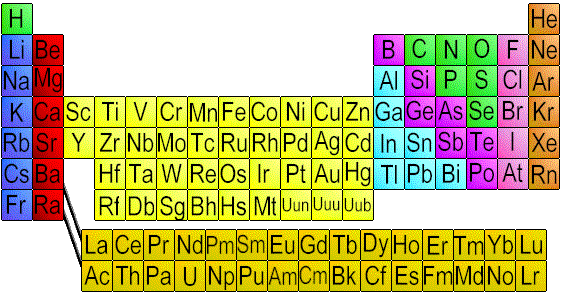 a) 132, 55 Cs
132 mass units, 55 protons & electrons, 77 neutrons
b) 59, 27 Co
59 mass units, 27 protons & electrons, 32 neutrons
c) 163, 69 TM
169 mass units, 69 protons & electrons, 100 neutrons
d) 70, 30 Zn
65 mass units, 30 protons & electrons, 35 neutrons
65. How many electrons, protons, and neutrons are contained in each of the following atoms?
a) gallium-64
64 mass units, 32 protons & electrons, 32 neutrons
b) flourine-23
20 mass units, 9 protons & electrons, 11 neutrons
c) titanium-48
48 mass units, 22 protons & electrons, 26 neutrons
d) helium-8
8 mass units, 2 protons & electrons, 6 neutrons
68. Data for chromium's four naturally occurring isotopes is provided in the table found in the book. Calculate chromium's atomic mass.
52.1 amu
72. Complete the table below.
85. If atoms are primarily composed of empty space, why can't you pass your hand through a solid object?
The atoms are so tightly compacted together they won't break apart.
Wednesday, September 7, 2011
Separation Techniques and Understanding
There are a few separation techniques worth knowing, and those are Filtration, Distillation, Chromatography, and Centrifugation. Here's how we applied these to our Separation Project!
 Filtration-
First separation project: Filtered the sand to separate calcium chloride using a wire net
Def. to pass through or as through a filter.
 Distillation-
Neither separation project!
Def. the purification or concentration of a substance, the obtaining of the essence or volatile properties contained init, or the separation of one substance from another, by such a process.

Chromatography-
Second separation project: The ink was spreading out on the filter paper
Def. separation of mixtures into their constituents by preferential adsorption by a strip of filter paper

Centrifugation-
Neither separation project!
Def. spinning a mixture to separate substances
Filtration-First separation project: Filtered the sand to separate calcium chloride using a wire net
Def. to pass through or as through a filter.
Distillation-Neither separation project!
Def. the purification or concentration of a substance, the obtaining of the essence or volatile properties contained init, or the separation of one substance from another, by such a process.
Chromatography-
Second separation project: The ink was spreading out on the filter paper
Def. separation of mixtures into their constituents by preferential adsorption by a strip of filter paper
Centrifugation-
Neither separation project!
Def. spinning a mixture to separate substances
Search Results
Separation Lab
For this experiment, my partner was Ashley. We traded our mixture (ours containing sand, calcium chloride, and suger) with Joel, Sam, and Damien for theirs. First, we measured the "strange substance" and subtracted the original weight of the beaker it was in, getting 413.1g. After this, we sifted the mixture which separated sand (41.3g), and iron (154.9g) from the calcium. Once the calcium was out, we put it in water so it could melt to separate the liquids from solids and used filter paper. From there, we measured that to be 216.9g. Then we went through the sand and iron mixture with a magnet to separate those two and get our weight results (as seen earlier in this blog!) soon after.
Tuesday, September 6, 2011
Ink Separation Lab
In this lab, we took some simple ingredients: filter paper, markers, water, something to hold the water, and a small paper towel. First, we took multiple colors and drew something simple onto the filter paper. From there, we poked a hole into the center of the filter paper and put a piece of rolled of paper towel into the hole so that some may be sticking out on both sides. Next, we got our small container and put water in it. Filter paper (and paper towel, now in it) were placed above the water so that the paper towel may absorb the water and carry it up, spreading the water out onto the filter paper, mixing the colors across it. We noticed something funny about the colors, though! It seems that yellow is always closest to the center, and blue is always on the outer edge! From this, we concluded that the molecules in the yellow ink are heavier, and the molecules in the blue ink are much lighter, allowing for them to spread further.
Wednesday, August 31, 2011
Subscribe to:
Comments (Atom)