28. Complete the concept map using the appropriate terms
1.) matter
2.) atoms
3.) electrons
4.) neutrons
5.) protons
6.) empty space around nucleus
7.) nucleus
35. What experimental results led to the conclusion that electrons were part of all forms of matter?
The cathode ray experiment led to this conclusion.
39. Explain what keeps the electrons confined in the space surrounding the nucleus.
Electron have an attraction to the nucleus.
40. Describe the flow of a cathode ray inside a cathode ray tube.
Rays travel from the cathode to the anode.

Well, since 40 is on top, that is the mass number, and the bottom number is the atomic number.
51. Explain how to determine the number of neutrons an atom contains if you know its mass number and its atomic number.
Subtract the atomic number from the mass number!
60. For each of the following chemical symbols, determine the element name and the number of protons and electrons an atom contains.
a) V
Vanadium protons 23 protons & electrons
b) Mn
Maganese- 25 protons & electrons
c) Ir
Iridium-77 protons & electrons
d) S
Sulfur-16 protons & electrons
64. How many electrons, protons, and neutrons are contained in each of the following atoms?
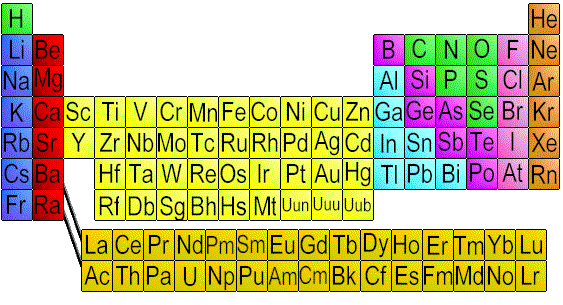 a) 132, 55 Cs
132 mass units, 55 protons & electrons, 77 neutrons
b) 59, 27 Co
59 mass units, 27 protons & electrons, 32 neutrons
c) 163, 69 TM
169 mass units, 69 protons & electrons, 100 neutrons
d) 70, 30 Zn
65 mass units, 30 protons & electrons, 35 neutrons
65. How many electrons, protons, and neutrons are contained in each of the following atoms?
a) gallium-64
64 mass units, 32 protons & electrons, 32 neutrons
b) flourine-23
20 mass units, 9 protons & electrons, 11 neutrons
c) titanium-48
48 mass units, 22 protons & electrons, 26 neutrons
d) helium-8
8 mass units, 2 protons & electrons, 6 neutrons
68. Data for chromium's four naturally occurring isotopes is provided in the table found in the book. Calculate chromium's atomic mass.
52.1 amu
72. Complete the table below.
85. If atoms are primarily composed of empty space, why can't you pass your hand through a solid object?
The atoms are so tightly compacted together they won't break apart.

No comments:
Post a Comment