In this lab, we looked through spectroscopes to see light spectrums. There are three spectra. Those are Continuous, Emission, and Absorption.
Continuous Spectra (all the colors)
red yellow green blue purple
Emission
red yellow green
Absorption
red brown yellow green purple
After covering this, we got creative and started looking through the spectroscopes when a jarred chemical is placed in front of the light.
Hydrogen
red green purple
Mercury
red orange green purple
Nitrogen
red orange yellow green blue purple
Argon
red orange green purple
Helium
red orange green blue
Neon
red orange yellow green blue purple
Wednesday, September 28, 2011

Tuesday, September 20, 2011
Ch. 4 test review
Today, we're reviewing for the test coming up! Questions are found on pg. 113 in the book. Enjoy!
28. Complete the concept map using the appropriate terms
1.) matter
2.) atoms
3.) electrons
4.) neutrons
5.) protons
6.) empty space around nucleus
7.) nucleus
35. What experimental results led to the conclusion that electrons were part of all forms of matter?
The cathode ray experiment led to this conclusion.
39. Explain what keeps the electrons confined in the space surrounding the nucleus.
Electron have an attraction to the nucleus.
40. Describe the flow of a cathode ray inside a cathode ray tube.
Rays travel from the cathode to the anode.
 50. What do the superscript and subscript in 40, 19 K represent?
Well, since 40 is on top, that is the mass number, and the bottom number is the atomic number.
51. Explain how to determine the number of neutrons an atom contains if you know its mass number and its atomic number.
Subtract the atomic number from the mass number!
60. For each of the following chemical symbols, determine the element name and the number of protons and electrons an atom contains.
a) V
Vanadium protons 23 protons & electrons
b) Mn
Maganese- 25 protons & electrons
c) Ir
Iridium-77 protons & electrons
d) S
Sulfur-16 protons & electrons
64. How many electrons, protons, and neutrons are contained in each of the following atoms?
 a) 132, 55 Cs
132 mass units, 55 protons & electrons, 77 neutrons
b) 59, 27 Co
59 mass units, 27 protons & electrons, 32 neutrons
c) 163, 69 TM
169 mass units, 69 protons & electrons, 100 neutrons
d) 70, 30 Zn
65 mass units, 30 protons & electrons, 35 neutrons
65. How many electrons, protons, and neutrons are contained in each of the following atoms?
a) gallium-64
28. Complete the concept map using the appropriate terms
1.) matter
2.) atoms
3.) electrons
4.) neutrons
5.) protons
6.) empty space around nucleus
7.) nucleus
35. What experimental results led to the conclusion that electrons were part of all forms of matter?
The cathode ray experiment led to this conclusion.
39. Explain what keeps the electrons confined in the space surrounding the nucleus.
Electron have an attraction to the nucleus.
40. Describe the flow of a cathode ray inside a cathode ray tube.
Rays travel from the cathode to the anode.

Well, since 40 is on top, that is the mass number, and the bottom number is the atomic number.
51. Explain how to determine the number of neutrons an atom contains if you know its mass number and its atomic number.
Subtract the atomic number from the mass number!
60. For each of the following chemical symbols, determine the element name and the number of protons and electrons an atom contains.
a) V
Vanadium protons 23 protons & electrons
b) Mn
Maganese- 25 protons & electrons
c) Ir
Iridium-77 protons & electrons
d) S
Sulfur-16 protons & electrons
64. How many electrons, protons, and neutrons are contained in each of the following atoms?
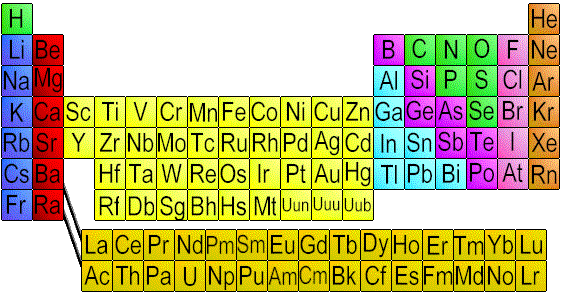 a) 132, 55 Cs
132 mass units, 55 protons & electrons, 77 neutrons
b) 59, 27 Co
59 mass units, 27 protons & electrons, 32 neutrons
c) 163, 69 TM
169 mass units, 69 protons & electrons, 100 neutrons
d) 70, 30 Zn
65 mass units, 30 protons & electrons, 35 neutrons
65. How many electrons, protons, and neutrons are contained in each of the following atoms?
a) gallium-64
64 mass units, 32 protons & electrons, 32 neutrons
b) flourine-23
20 mass units, 9 protons & electrons, 11 neutrons
c) titanium-48
48 mass units, 22 protons & electrons, 26 neutrons
d) helium-8
8 mass units, 2 protons & electrons, 6 neutrons
68. Data for chromium's four naturally occurring isotopes is provided in the table found in the book. Calculate chromium's atomic mass.
52.1 amu
72. Complete the table below.
85. If atoms are primarily composed of empty space, why can't you pass your hand through a solid object?
The atoms are so tightly compacted together they won't break apart.
Wednesday, September 7, 2011
Separation Techniques and Understanding
There are a few separation techniques worth knowing, and those are Filtration, Distillation, Chromatography, and Centrifugation. Here's how we applied these to our Separation Project!
 Filtration-
First separation project: Filtered the sand to separate calcium chloride using a wire net
Def. to pass through or as through a filter.
 Distillation-
Neither separation project!
Def. the purification or concentration of a substance, the obtaining of the essence or volatile properties contained init, or the separation of one substance from another, by such a process.

Chromatography-
Second separation project: The ink was spreading out on the filter paper
Def. separation of mixtures into their constituents by preferential adsorption by a strip of filter paper

Centrifugation-
Neither separation project!
Def. spinning a mixture to separate substances
Filtration-First separation project: Filtered the sand to separate calcium chloride using a wire net
Def. to pass through or as through a filter.
Distillation-Neither separation project!
Def. the purification or concentration of a substance, the obtaining of the essence or volatile properties contained init, or the separation of one substance from another, by such a process.
Chromatography-
Second separation project: The ink was spreading out on the filter paper
Def. separation of mixtures into their constituents by preferential adsorption by a strip of filter paper
Centrifugation-
Neither separation project!
Def. spinning a mixture to separate substances
Search Results
Separation Lab
For this experiment, my partner was Ashley. We traded our mixture (ours containing sand, calcium chloride, and suger) with Joel, Sam, and Damien for theirs. First, we measured the "strange substance" and subtracted the original weight of the beaker it was in, getting 413.1g. After this, we sifted the mixture which separated sand (41.3g), and iron (154.9g) from the calcium. Once the calcium was out, we put it in water so it could melt to separate the liquids from solids and used filter paper. From there, we measured that to be 216.9g. Then we went through the sand and iron mixture with a magnet to separate those two and get our weight results (as seen earlier in this blog!) soon after.
Tuesday, September 6, 2011
Ink Separation Lab
In this lab, we took some simple ingredients: filter paper, markers, water, something to hold the water, and a small paper towel. First, we took multiple colors and drew something simple onto the filter paper. From there, we poked a hole into the center of the filter paper and put a piece of rolled of paper towel into the hole so that some may be sticking out on both sides. Next, we got our small container and put water in it. Filter paper (and paper towel, now in it) were placed above the water so that the paper towel may absorb the water and carry it up, spreading the water out onto the filter paper, mixing the colors across it. We noticed something funny about the colors, though! It seems that yellow is always closest to the center, and blue is always on the outer edge! From this, we concluded that the molecules in the yellow ink are heavier, and the molecules in the blue ink are much lighter, allowing for them to spread further.
Subscribe to:
Comments (Atom)